Pre-built Connectors
Pre-built connectors allow you to integrate your business systems with Sentinel EMS directly from the business system user interface (UI). These connectors function as add-ons, eliminating the need to learn about APIs or write code, and instantly creating integration flows.
The following connectors are supported in Sentinel Connect:
>Salesforce
>Zuora
>SAP
>MS Dynamics
Contact your Thales sales representative if you do not see the connector you are looking for.
This topic primarily focuses on the Salesforce connector, detailing its user-level settings and field mappings. For information on configuring our range of ready-to-use connectors, and mapping configurations related specifically to SAP and Zuora connectors, please see the Configuring Pre-built Connectors page.
NOTE Thales supports configuring mappings directly in the Sentinel Connect app for the out-of-the-box connectors for MS Dynamics and Salesforce. Mapping configurations for SAP and Zuora are managed in the Sentinel Connect.
Each pre-built connector has its own login and configuration requirements, with settings unique to the business system (ERP/CRM) with which it is integrated. The next section discusses these settings specifically in Salesforce. Contact Thales Customer Support for assistance with pre-built connector configuration settings.
Sentinel User Setting in Salesforce
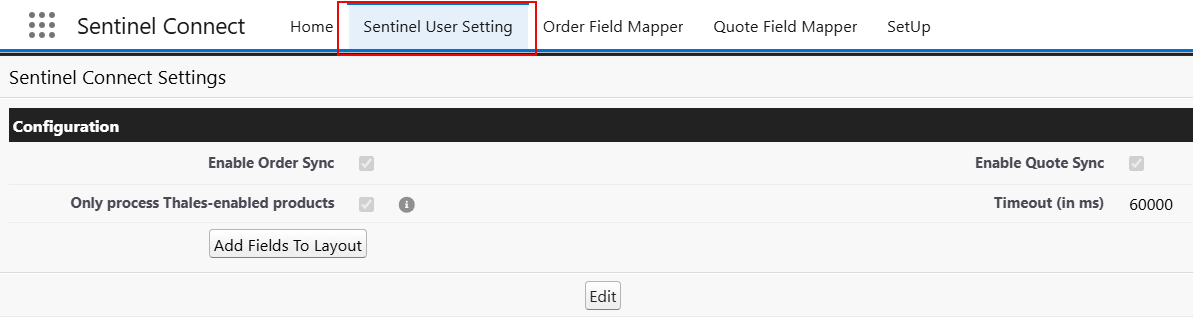
The Sentinel User Setting tab contains user-level configurations that users must set to trigger and access the connector functionality from Salesforce. These settings are the global settings that govern the order and quote processing from the Salesforce connector to Sentinel Connect.
>Enable Order Sync: Allows automatic synchronization of all order updates between Salesforce and Sentinel Connect, ensuring order data stays updated across systems. This checkbox is cleared by default, so order data is not pushed from Salesforce to Sentinel Connect unless selected.
>Enable Quote Sync: Allows automatic synchronization of all quote updates between Salesforce and Sentinel Connect, ensuring quote data stays updated across systems. This checkbox is cleared by default, so quote data is not pushed from Salesforce to Sentinel Connect unless selected.
>Only process Thales-enabled products: Ensures that Sentinel Connect processes only those products that have the Thales checkbox enabled in Salesforce. The 'Only process Thales-enabled products' checkbox does not apply to quotes.
The Thales checkbox, shown in the following screenshot, appears when you add a new product in Salesforce.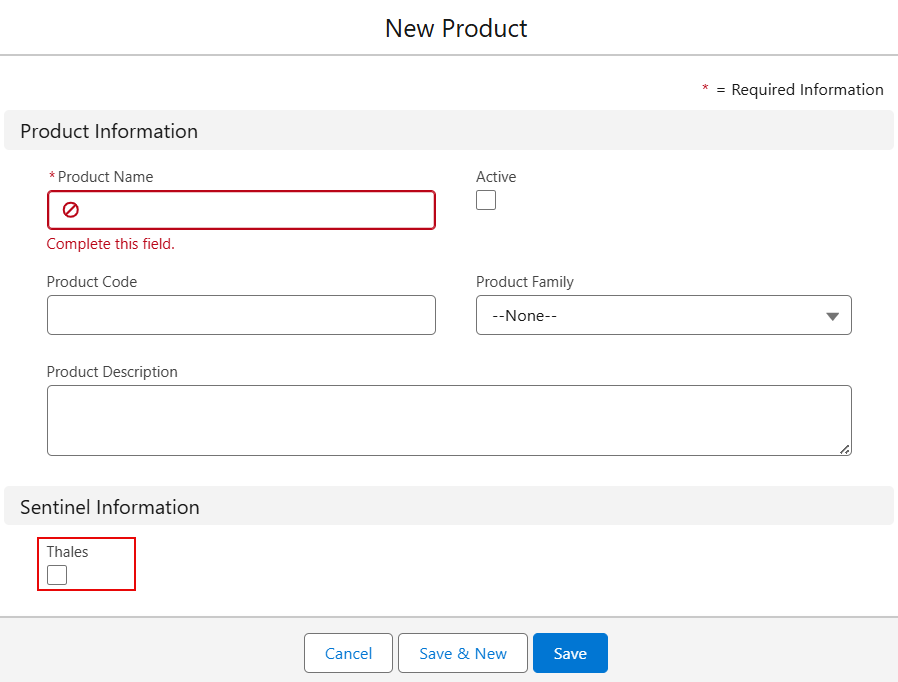
The Thales checkbox, shown in the following screenshot, appears when you edit an existing product in Salesforce.
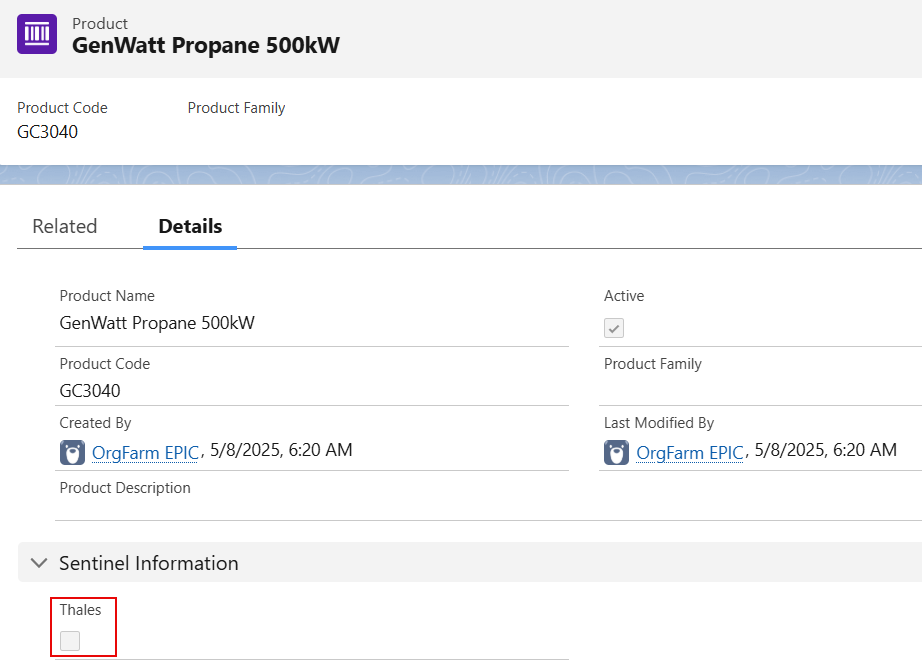
If a product already exists in Sentinel EMS, select Thales checkbox to enable automatic entitlement creation through Sentinel Connect. Products without the Thales checkbox enabled are skipped during processing. Selecting this option has the following advantages:
•Avoid 400 errors
•Reduce dashboard noise
•Reduce transaction noise
•Improve debugging experience
When 'Only process Thales-enabled products' checkbox is selected and the order does not contain any Thales-enabled products, a user can see the warning message in Salesforce Order details "Order Skipped: Orders without Thales-enabled products are excluded from the Sentinel Connect submission" and the transaction is not logged.
NOTE By default, Only process Thales-enabled products checkbox is selected when Sentinel Connect version 2.7 is installed in the Salesforce instance. In the case of an upgrade from a previous version, this option is cleared.
Clear the 'Only process Thales-enabled products' checkbox to allow Sentinel Connect to process all products, regardless of whether the Thales checkbox is enabled. This may result in processing errors for products without the Thales checkbox enabled.
>Timeout (in ms): Specify the duration, in milliseconds, that the system waits after triggering a Sentinel Connect request before timing out. When a Sentinel Connect request is initiated from this point, the system waits for a response up to the specified timeout value.
NOTE Set the timeout to '60000' ms or higher to allow sufficient time for the system to receive a response.
>Add Fields To Layout: The Add Fields To Layout button helps administrators automatically add Sentinel Connect-required custom fields to selected Salesforce object page layouts, without manually editing layouts in Salesforce Setup. This ensures that all required Sentinel Connect fields are consistently available on relevant Salesforce objects used by the connector.
When you select Add Fields To Layout, a modal window opens that allows users to select page layouts. The dropdown lists all available layouts (both standard and custom) for the selected Salesforce object, allowing administrators to choose the exact layout to which the fields should be added. Each layout option corresponds to a specific Salesforce object. Selecting a layout adds Sentinel Connect–related fields to that object’s page layout under a dedicated Sentinel Information section. Users can select one or more layouts and click Add to apply the changes.
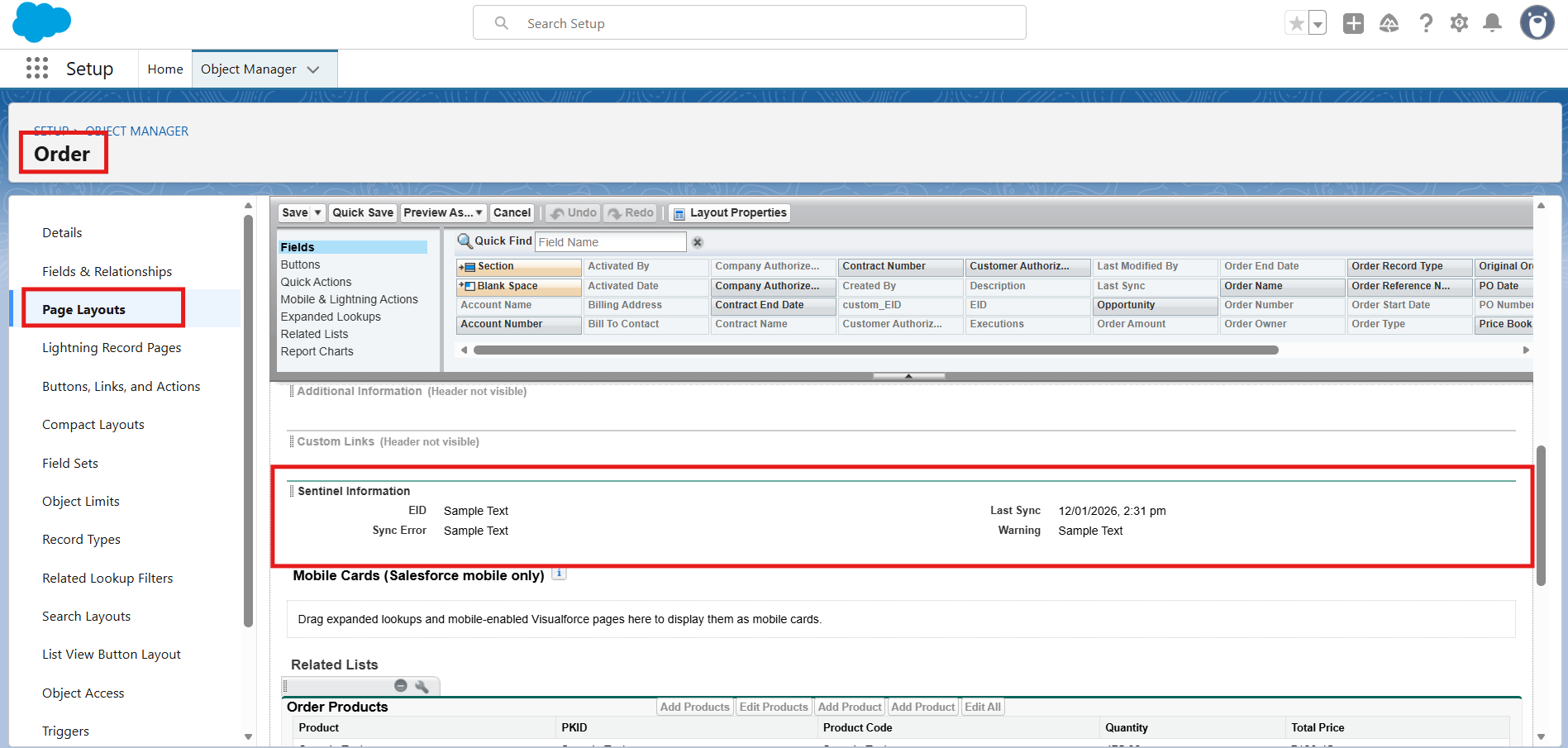
Following are the layout options and the fields added in each layout:
•Order Layout:: Adds the following fields to the Order object layout:
–EID
–Last Sync
–Sync Error
–Warning
These fields are used to track synchronization status, errors, and warnings related to order processing.
•Quote Layout: Adds the following fields to the Quote object layout:
–EID
–Last Sync
–Sync Error
–Warning
These fields provide visibility into quote-level synchronization and processing status.
•Product Layout: Adds the following field to the Product object layout:
–Thales
This field identifies products that are eligible for Sentinel processing.
•OrderItem Layout: Adds the following field to the OrderItem (Order Product) object layout:
–PKID
This field captures product-level identification from processed order.
Validation and user feedback
The system provides the following validation messages and user feedback during layout selection and updates:
>If no layout is selected, the system displays a warning: “Please select a layout.”
>If selected fields already exist on the layout, the user is informed, and no duplicate fields are added.
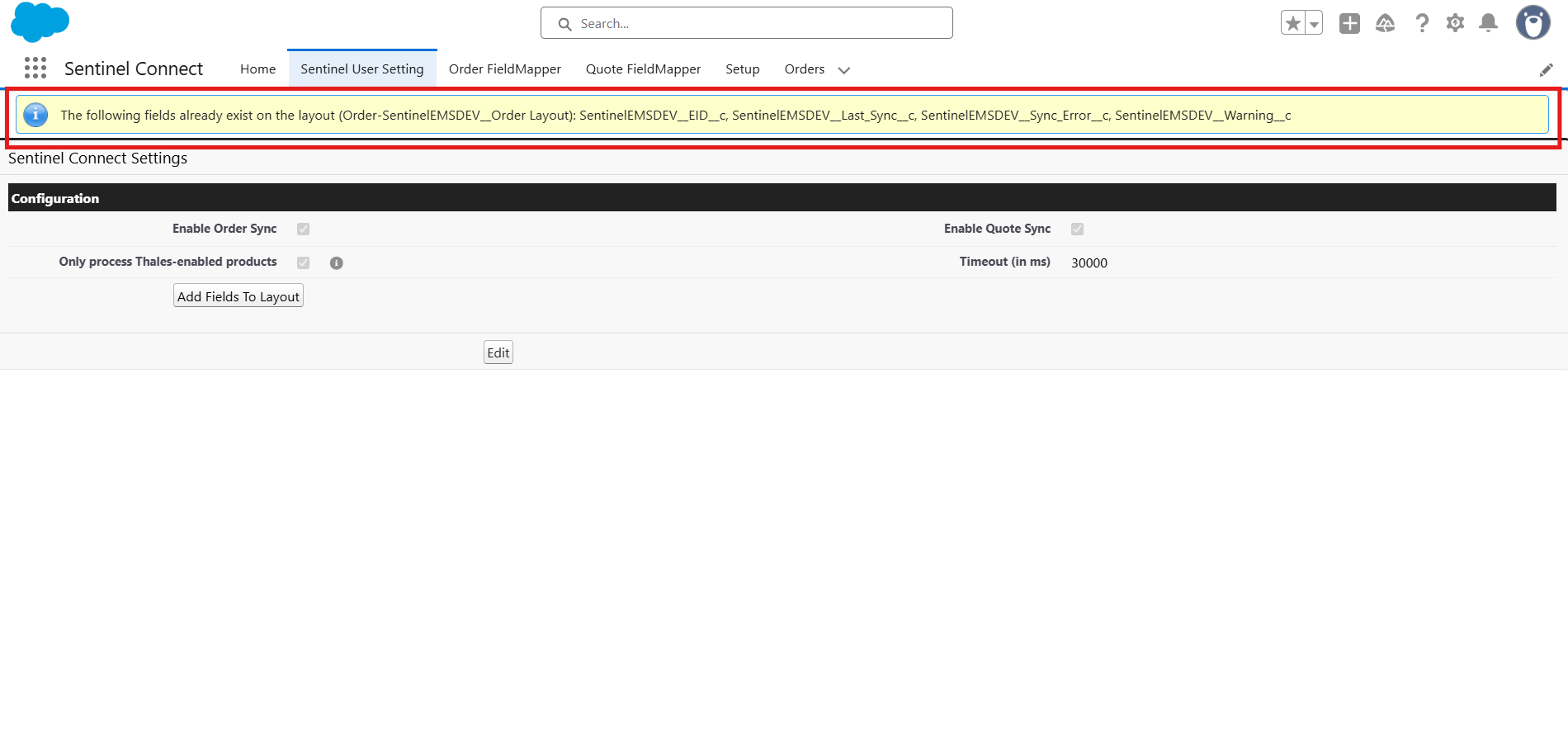
>Any errors during layout updates (for example, permission-related issues) are displayed as clear error messages.
Setup
The Setup tab performs a one-time configuration required to enable Sentinel Connect functionality on Salesforce Quotes. Once completed, the setup cannot be re-run.
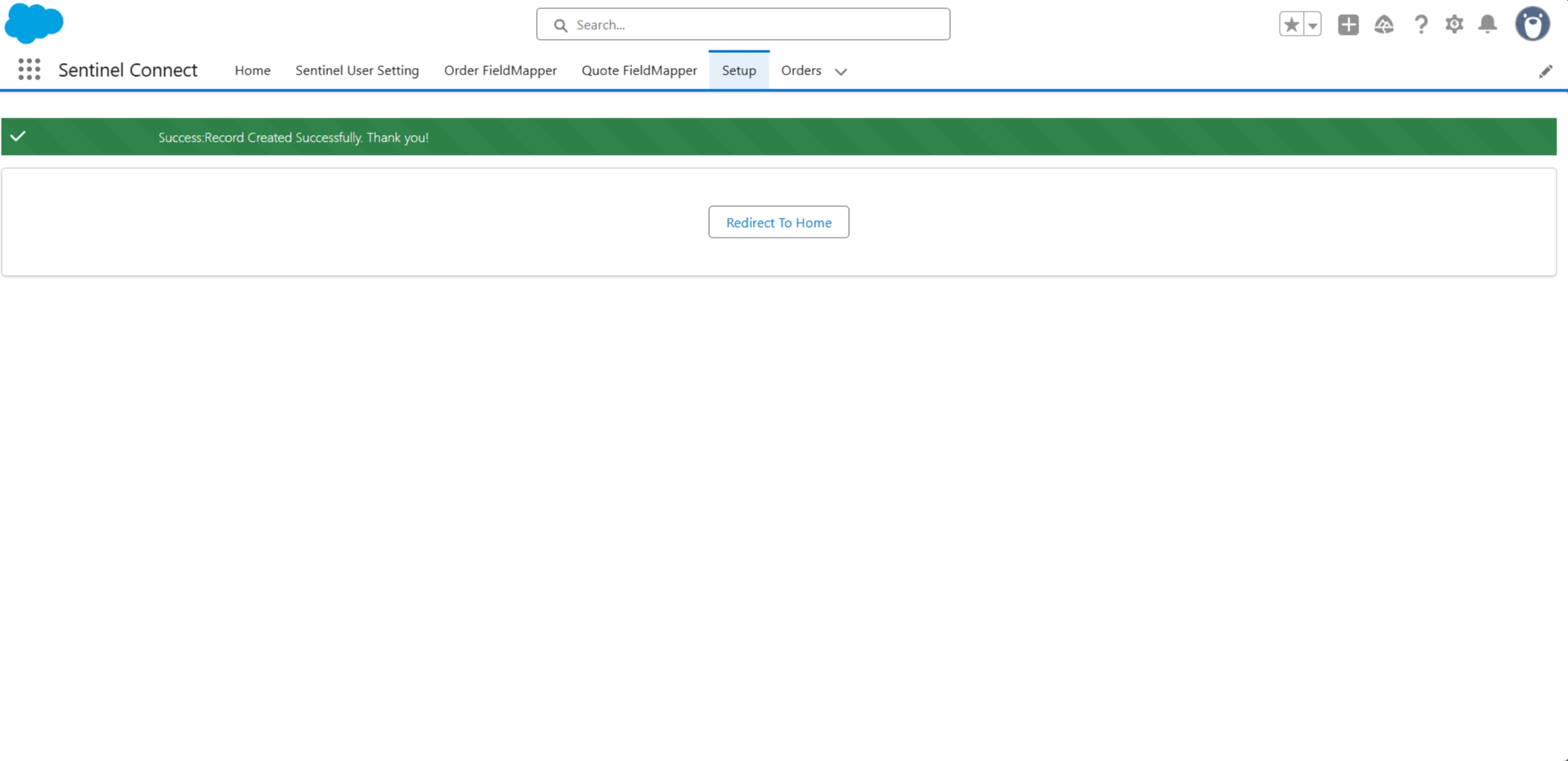
Executing setup ensures that all required quote-related components are created upfront, allowing Sentinel Connect to work seamlessly with Salesforce Quotes while minimizing manual configuration. Executing setup performs the following configurations:
>Adds required Sentinel Connect configuration fields — EID, Last Sync, Sync Error, and Warning — to the Quote object.
>Adds required automation triggers to the Quote object to support quote processing.
>Creates and prepares the custom object Quote_JSON__c in the instance, which tracks processed Quote records.
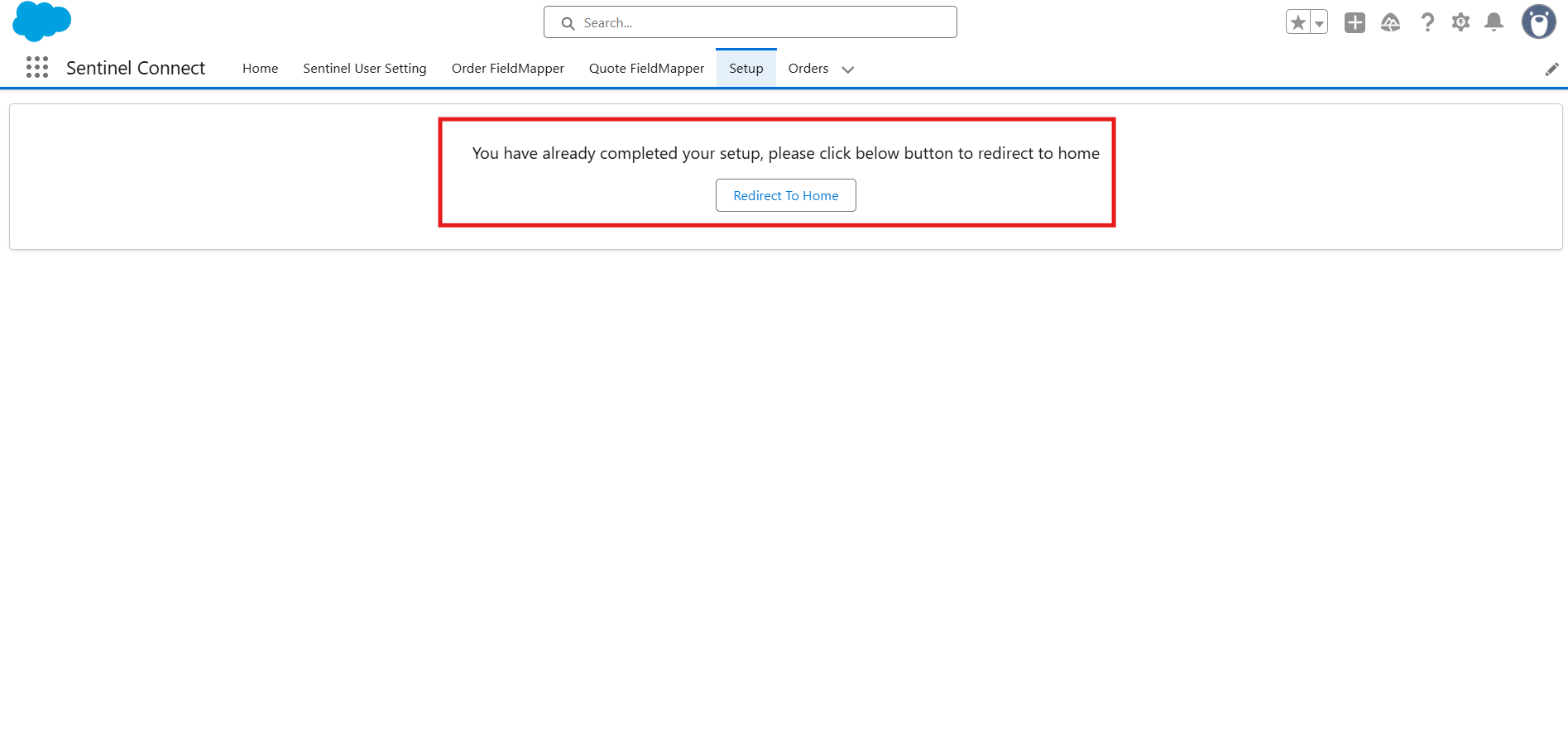
Additional notes on Setup
>Setup runs only when Salesforce Quotes are enabled in the Salesforce. When Salesforce Quotes are not enabled, setup is skipped and quote-related configuration is not applied.
>Setup applies only to Non-CPQ managed packages. Salesforce CPQ instances do not support this setup process.
Field Mapping Framework
The Field Mapping Framework facilitates the transformation and transfer of data from a business system (source) to Sentinel EMS (target). This framework allows administrators to define exactly how transactional data (such as Orders, Line Items, Customers, Partners, and Contacts) is interpreted by Sentinel EMS.
Field Mapper Interface
The field mappers within the connectors are a set of UI forms that enable you to easily bind data from your business system to a specific field in Sentinel EMS, and vice versa.
Accessing the Field Mapper
The entry point to the mapping screen varies depending on the connected business system:
|
Connector |
Access Path |
|---|---|
|
Salesforce |
Salesforce > Open App Launcher > Sentinel Connect > Order Field Mapper or Quote Field Mapper |
|
SAP |
Sign in to Sentinel Connect as a Customer Admin* > Client Management > Order Configuration or Quote Configuration |
|
Zuora |
Sign in to Sentinel Connect as a Customer Admin* > Client Management > Order Configuration |
| Microsoft Dynamics |
MS Dynamics 365 > Sentinel Connect > Order Field Mapper |
*See Configuring User Accounts for more information on user roles and permissions.
Mapping Screen Components
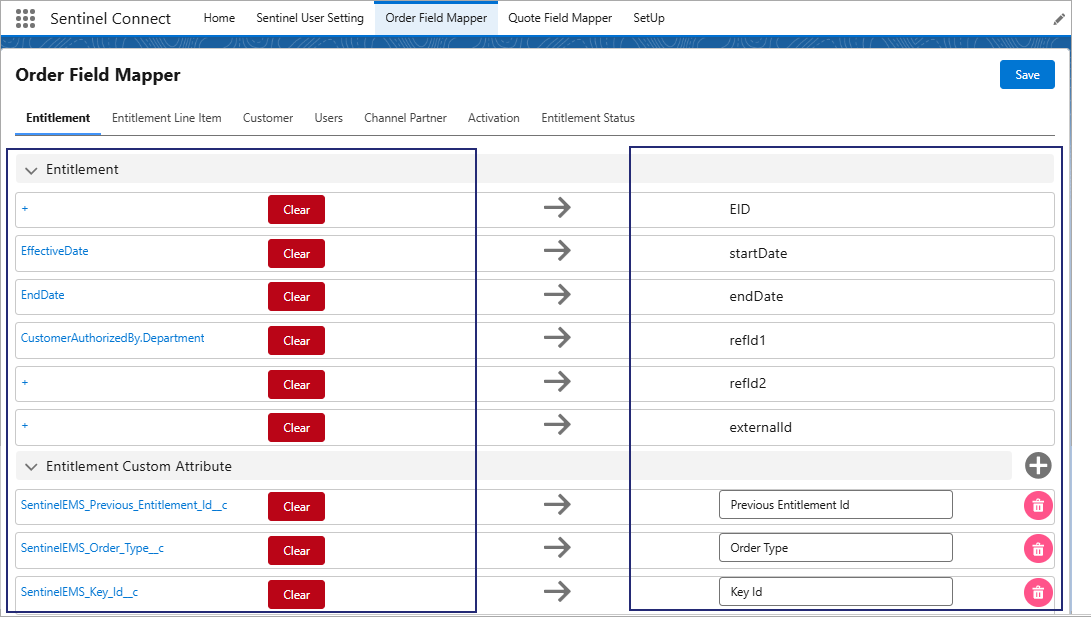
The Field Mapping screen is divided into two distinct panels:
>Left Panel (the Source Field from Business System): Displays ERP-specific fields, which are the data points available from the upstream object (for example, Source Order Number, Source Customer ID).
>Right Panel (the Target Field from Sentinel EMS): Displays Sentinel EMS attributes or data fields, which are the destination fields within Sentinel EMS.
Order Field Mapper: Supported Entities and Field Mappings
Mappings can be defined for following key business entities:
>Entitlement
>Entitlement Line Item or Product
>Customer
>Users
>Channel Partner
The Order Field Mapper is a user interface within the business system (for example, Salesforce) that enables flexible and precise data mapping between Salesforce and Sentinel EMS attributes for orders.
Attribute Types
Target attributes in Sentinel EMS are categorized into two types:
>Standard Attributes: Standard Attributes are available by default in the right-side panel and represent core system data (e.g., Entitlement ID, Start Date, Product Name).
>Custom Attributes: Custom Attributes are user-defined attributes required when the business system contains data that does not map to a Standard Attribute. Custom attributes that exist in Sentinel EMS are not available by default on the Field Mapper screen. To enable mapping, the business system administrator or Sentinel Connect Customer Administrator must add these attributes by clicking the “+” icon in the Custom Attribute Section of the relevant Entity Tab and entering the name of the custom attribute to be mapped in the target system. Field names may vary as they are defined according to the customer-specific data model in Sentinel EMS.
NOTE When creating a new attribute in the source business system, ensure that you use a unique and descriptive name (e.g., Order_Type__c) to prevent conflicts with existing ERP field names. This practice helps maintain data integrity and ensures smooth integration between ERP and Sentinel EMS.
Configure Field Mappings
Installation of the Sentinel Connect package into business systems creates default mappings for each object type (e.g., Entitlement, Product). If no mapping is defined, the user can click the “+” sign in the mapping row to define one.
The following tables describe the supported entities and demonstrate how Sentinel Connect configuration works within the Salesforce application.
Source fields (from Salesforce) are not prescribed in this table due to the variation in business requirements, data models, and source fields across different business systems. The business system administrator should select the fields that best align with their own system configuration and business processes.
>Entitlement: This tab controls the core entitlement data, allowing you to transfer order details from Salesforce to Sentinel EMS fields.
NOTE Specific custom attributes are required to handle renewal or continuous order logic.
 Entitlement Field Mapping Reference
>Entitlement Line Item or Product: This tab maps the specific products within an order. The License Model Attribute section allows you to overwrite default license terms at the line-item level.
NOTE Product bundles always use the default License Model attribute values configured in Sentinel EMS. You can override quantity only for products.
Entitlement Line Item Field Mapping Reference
>Customer: This tab maps the customer details from Salesforce to Sentinel EMS.
Customer Field Mapping Reference
>Users: This tab controls the mapping of Users (contact) data associated with a customer.
>Channel Partner: This tab maps the channel partner details from Salesforce to Sentinel EMS fields. Use this tab if your sales model involves distributors or resellers.
Channel Partner Field Mapping Reference
>Activation: This tab maps activation-related fields such as activation date, code, or custom attributes. This ensures accurate transfer of activation data between source and target systems during order processing.
NOTE The following considerations apply during activation:
>The Activation tab is available only in the Order Field Mapper in the Salesforce connector.
>Automatic activation is supported only for products. If an order contains product bundles, activate the product bundles manually in Sentinel EMS.
Activation Field Mapping Reference
>Entitlement Status: This tab maps the entitlement status details from Salesforce to Sentinel EMS fields.
NOTE The Entitlement Status tab is available only in the Order Field Mapper.
Entitlement Status Field Mapping Reference
Mapping Methodologies
There are two ways to instruct the system on how to fill in the data fields:
>Dynamic Mapping (Variable Data): Use this method to link specific data from your source ERP to a target Sentinel EMS standard or custom attribute.
•You map a specific source field (such as Order.id, Customer.Name, or Quantity) to the target Sentinel EMS attribute.
•Unique data for every order (e.g., Order 101, Order 102) is preserved in Sentinel EMS.
>Fixed Value Mapping (Static Data): Use this method to stamp a single, permanent value onto every transaction, regardless of the source data.
•Instead of selecting an ERP field, you manually type a specific text, number, or Boolean value (e.g., "Region: US-East"). For details, see Supported Data Types for Fixed Values.
•Identical data is applied to all orders in this workflow.
Supported Data Types for Fixed Values
The Salesforce connector enables users to assign a fixed value (string, integer, or Boolean data type) to any attribute in Sentinel EMS. The input is validated based on the selected data type before being mapped. You can enter fixed values of the following data types:
>String
>Integer
>Boolean (True/False)
For each attribute in the Quote or Order Field Mapper, the input is validated based on the selected data type before being mapped to Sentinel EMS.
NOTE Fixed values are not supported for date-type Sentinel EMS attributes. If you attempt to assign a fixed value to these date fields, the interface blocks the mapping and shows a restriction message.
The Fixed Values have the following data type considerations:
•Standard Attributes: For standard Sentinel EMS attributes such as entitlement attributes, the system respects the predefined attribute data type when mapping a fixed value. For instance, if 'refid1' is a string-type attribute, only string values are allowed to be assigned as fixed values.
•Custom Attributes: For custom Sentinel EMS attributes, there is no data type validation when mapping fixed values. Unlike standard entities, all fixed values are treated as strings during mapping. Therefore, while users can input any data type (string, integer, or Boolean), they must ensure that the fixed values align with the attribute’s actual data type as defined in Sentinel EMS.
NOTE String values are limited to 255 characters due to Salesforce field constraints.
Salesforce Field Mapping Examples
Map Salesforce Values to Sentinel EMS Attributes
The Salesforce connector enables users to assign a fixed (or constant) value, whether string, integer, or Boolean data type, to any attribute (standard and custom attributes) in Sentinel EMS while mapping orders and quotes using the Field Mapper interface. This enhancement overcomes the previous limitation where only Salesforce fields could be mapped to Sentinel EMS attributes. By using fixed values in the data-mapping process, users can ensure consistent value mapping across all orders and prevent invalid data entry.
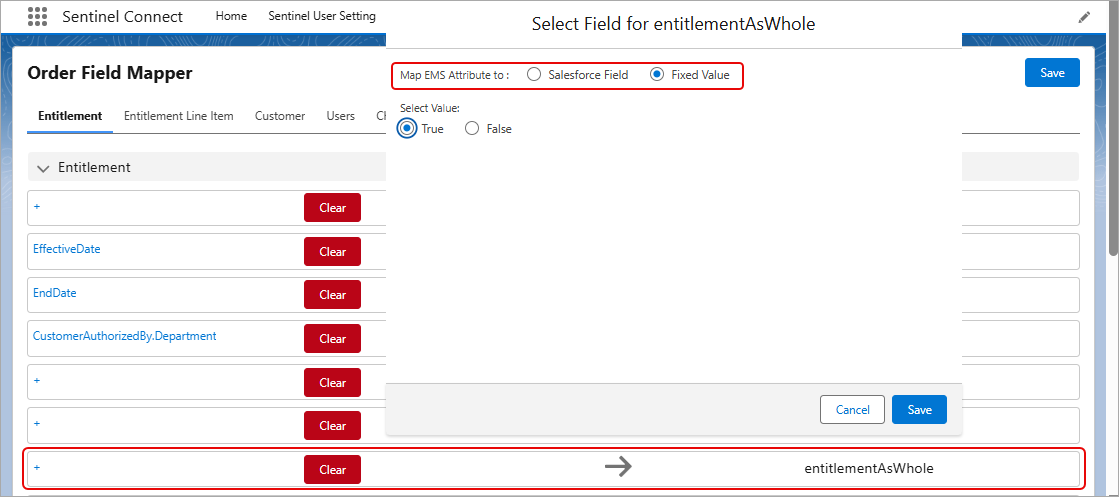
Steps to Map an Order Field
1.Go to Order Field Mapper in the Salesforce Connector UI.
2.Click the entity tab corresponding to the field you want to map.
3.Click plus (+) next to the field you want to map. This opens the screen to choose the field you want to map.
4.Select either Salesforce Field or Fixed Value.
•Salesforce field: Choose from the available fields in the list.
•Fixed Value: Enter a fixed value in the value input field. In case of a Boolean value, select 'True' or 'False'.
5. Click Save.
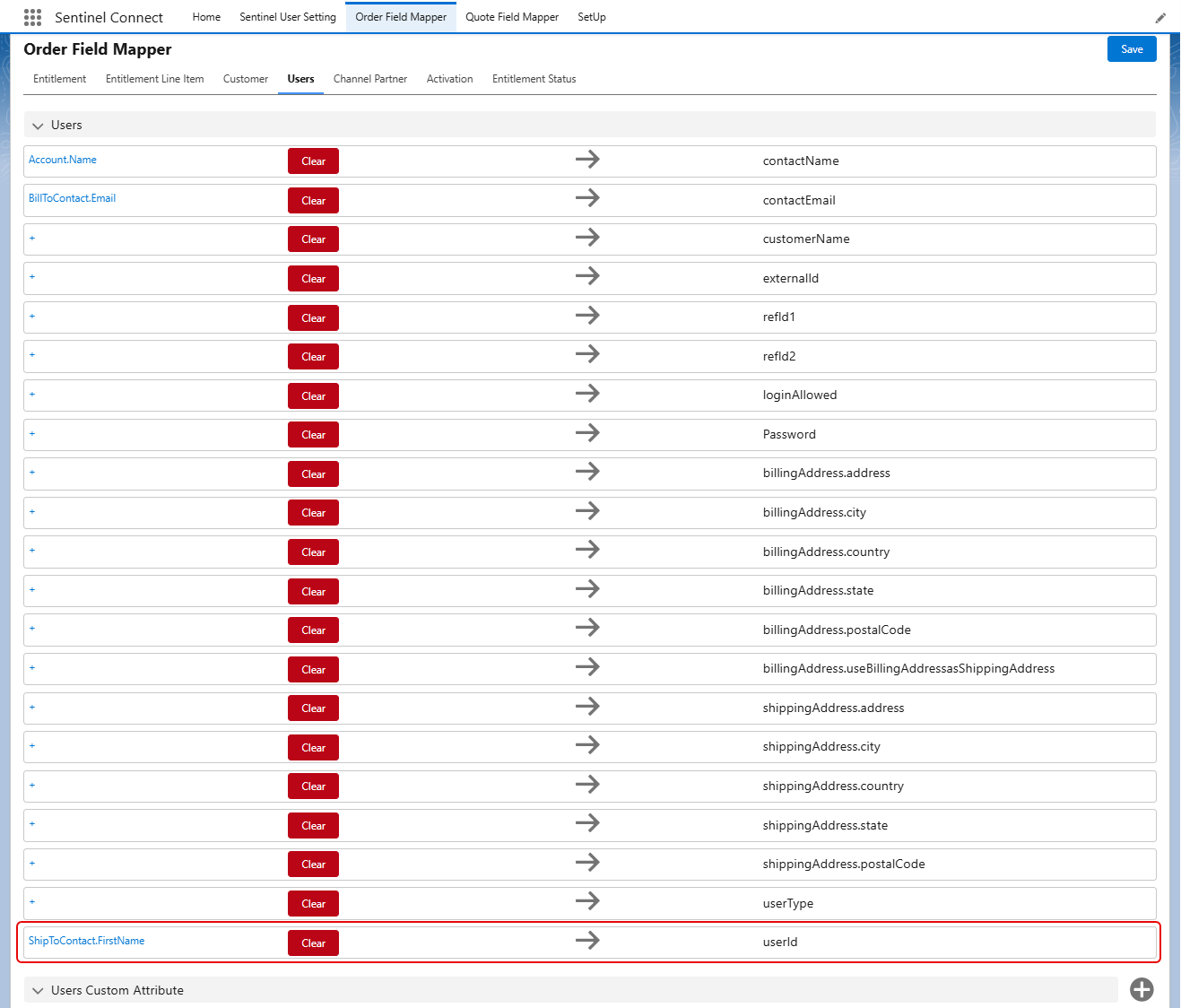
Map a User ID to Sentinel EMS
The Salesforce connector includes the userId field within the Users entity tab in the Field Mapper interface. This field is visible on the Users page under User Attributes in the Sentinel EMS UI. This enables seamless association of Salesforce user identifiers with Sentinel EMS user data.