
High Availability for On-Premises SL Network Licensing
Sentinel LDK High Availability provides licensing for on-premises SL network environments by distributing network licenses across a quorum comprising three License Managers. This architecture eliminates the dependency on a single License Manager. If one License Manager becomes unavailable, licensing services and active client sessions are managed by the remaining quorum members.
Traditionally, on-premises SL network licensing relied on a single License Manager, creating a single point of failure. If that License Manager became unavailable, licenses could no longer be served and active client sessions terminated, interrupting the protected application.
High availability with a three-License Manager quorum solves this problem by providing the following protections:
>Eliminating the Single Point of Failure: By running network licenses across three participating License Managers, the full pool of licenses and all active client sessions continue operating without interruption if any single License Manager fails.
>Preventing Unauthorized Duplicate License Usage: The 2-of-3 majority quorum rule ensures that network-isolated License Managers cannot independently grant licenses, preventing unauthorized duplicate license consumption across severed network segments.
High-Availability Architecture Overview
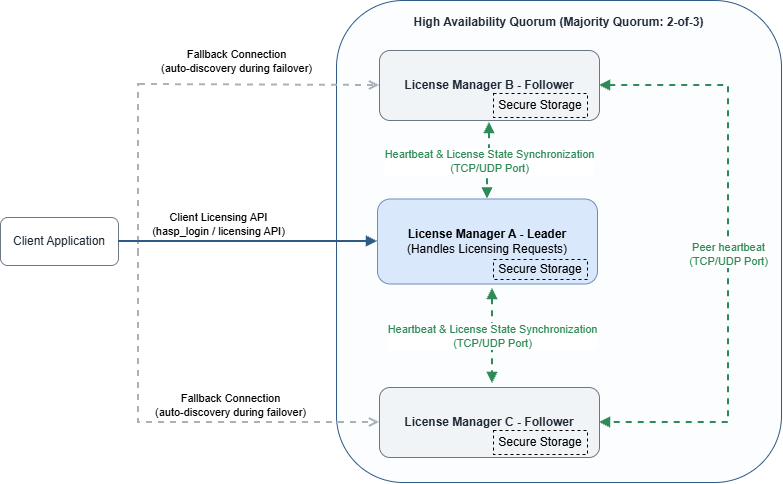
The following diagram provides a high-level overview of the architecture for high availability for SL Network Licensing within a three-License Manager quorum.
High-availability licensing is supported for Sentinel SL- AdminMode keys with concurrency. To configure high availability in Sentinel EMS, enable the High Availability option at the product level and ensure that all features in the product have concurrency enabled.
A Sentinel protection key configured for high availability can hold multiple high-availability products. Mixing high-availability products with standard products (products with high availability disabled) on the same protection key is not supported. Attempting to activate a high-availability product on a protection key that contains standard products results in an activation error in Sentinel EMS.
The 2-of-3 Majority Quorum Rule
High availability enforces a 2-of-3 majority quorum rule, meaning that at least two of the three participating License Managers must remain online and able to communicate. When this condition is met, quorum is maintained and licensing continues normally. The License Managers monitor one another through periodic heartbeats over the configured TCP/UDP port.
If the active leader becomes unavailable while quorum is maintained, the remaining License Managers detect the failure and automatically elect a new leader. Because active session state is replicated across the quorum, existing licensing sessions can continue through the newly elected leader with no additional action needed by the client.
If fewer than two License Managers can communicate, quorum is lost. An isolated License Manager immediately stops serving licenses to prevent split-brain operation and duplicate license consumption. Active sessions associated with that License Manager terminate, and new login attempts fail with HASP_HA_QUORUM_NOT_MET (Error 117). Licensing resumes when communication between at least two License Managers is restored.
Leader Election and Failover
The quorum manages leader election and failover automatically. You do not need to choose or manually configure which License Manager acts as the leader. When quorum is satisfied, leadership is established automatically as follows:
>Automatic Leader Election: The active License Managers automatically elect one License Manager as the leader. If the current leader becomes unavailable while quorum is maintained, the remaining License Managers automatically elect a new leader without administrator intervention.
>Leader Responsibilities: The elected leader License Manager alone is responsible for processing licensing transactions, managing and replicating active licensing state, and ensuring session consistency across the active quorum. Other participating License Managers act as followers.
>Automatic Failover: If the current leader becomes unreachable or disconnected, the active licensing sessions persist and transfer to the newly elected leader. Client applications are automatically redirected, preventing interruption to the protected software.
>Rejoining the Quorum: When an offline License Manager reconnects, peer discovery detects it and the License Manager automatically rejoins quorum operations.
High-Availability Supported Configurations
Following are the specifications for high-availability licensing:
>Supported Key Types: Limited to Sentinel SL-AdminMode keys with concurrency enabled. Sentinel HL hardware keys and Sentinel SL-UserMode keys are not supported.
>Storage Requirements: High availability operates on Secure Storage. Trusted Storage is not supported.
>Product Mixing Rules: A Sentinel protection key configured for high availability cannot contain standard products. Multiple high-availability products can be deployed on the same protection key. Mixing high-availability products and standard products on the same key is not supported.
>License Model Support: Perpetual, Expiration Date, and Time from License Generation models are supported with concurrency enabled. Execution Counter and Time from First Use license models are not supported on high-availability products. For details on each model, see Assigning License Terms to Features.
>Detach and Rehost: Detach and rehost operations are not supported for high-availability licenses. These options are disabled during license generation in Sentinel EMS.
>License Revocation: High-availability products do not support license revocation.
>Memory Operations: Pre-populated Read/Write and Read/Write Once memory files can be created during license generation in Sentinel EMS. However, the Licensing API runtime actively blocks write operations on high-availability keys and returns HASP_HA_WRITE_NOT_ALLOWED. Protected applications can read memory, but cannot write to memory at runtime.
>API Protocol Support: High-availability license consumption requires client integration using the C, .NET, or Java Sentinel Licensing API libraries. The Sentinel Licensing REST API does not support consuming high-availability licenses.
>Machine Allocation Best Practices: When deploying multiple high-availability protection keys, follow these machine allocation practices before hosting the keys:
•Use the same three License Managers, ensuring that all three machines are either all physical machines or all virtual machines.
•Use separate, dedicated three-License Manager quorums, ensuring that no machines are shared between the quorums.
For prerequisites, machine allocation best practices, and quorum setup procedures, see the Sentinel LDK Installation Guide.