
Features
|
>Prerequisites for Creating a Feature |
New to Sentinel EMS?
|
What Is a Feature?
A feature is a distinct functionality in a software application that can be independently licensed. Features are the basic building blocks
A feature can represent anything from a module to specific functionality such as Print, Save, or Draw, or an entire application.
For example, suppose you want to create a product called MySampleCalculator. You might include the following features:
| F1 | Add |
| F2 | Subtract |
| F3 | Multiply |
| F4 | Divide |
As part of your product monetization model, you might roll out the following flavors of the same product to the market:
>MySimpleCalculator (Add, Subtract)
>MyAdvancedCalculator (Add, Subtract, Multiply, Divide)
This lets you charge different prices according to feature usage.
Licensing Features
Sentinel EMS provides you the flexibility to apply a license model to each feature in a product. This helps to secure each feature and enables you to generate different types of licenses for a product according to your requirements.
Prerequisites for Creating a Feature
>A role that includes Catalog (Namespace) permissions for the relevant namespace.
Lifecycle Stages of a Feature
The Deployed attribute defines the lifecycle stage of a feature. A feature's lifecycle contains the following stages:
>Deployed: The feature is included in a product that is part of an entitlement.
>Not Deployed: The feature is not deployed if:
•The feature is not included in any product, OR
•The feature is included in a product that is marked as a draft, OR
•None of the products containing the feature are included in any entitlements.
Feature Status
The Status attribute on the Features page indicates whether the feature is active or obsolete.
Possible values:
>Completed: The feature is active. You can create products using this feature.
>End of Life: The feature is obsolete. You cannot edit or delete the feature, or associate it with any product. You can mark a feature as End of Life when it is no longer sellable to customers. You can change the status back to Completed to make the feature available again, if needed.
When you first create a feature, the status of the feature is set to Completed.
Creating a Feature
You create a feature from the Features page.
To create a feature:
1.From the navigation pane, select Catalog > Features to view the Features page.
2.Click the Add Feature button.
3.Fill in the feature attributes as shown in the following example.
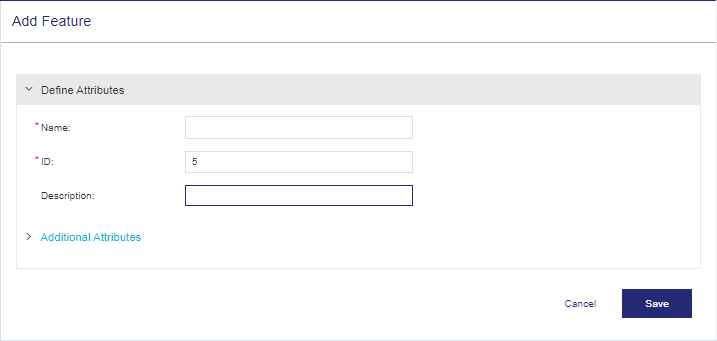
4.Click Save.
Feature Attributes
The following table explains the feature attributes:
| Attribute | Description | Required/Optional | Valid Values |
|---|---|---|---|
|
Namespace (Visible only if more than one namespace is available.) |
The namespace in which the feature is stored. |
Required |
Any namespace in the list |
| Name |
Name of the feature. The validity of the feature name depends on the enforcement in use. |
Required |
>1 to 50 characters >Cannot contain: < > |
| Identifier |
Unique identifier for the feature. During runtime, the Sentinel Licensing API call uses the Feature Identifier. Always ensure that the Feature Identifier is the same in both Sentinel EMS and the Sentinel LDK application you are using to protect your application (Sentinel LDK Envelope or Sentinel Licensing API). |
Required |
>Number from 1 to 65471 >The Name + Identifier combination must be unique across Sentinel EMS. (In other words, the same Name + Identifier combination cannot be used in multiple namespaces.) >Must be unique |
| Description | Additional information about the feature. | Optional |
>0 to 500 characters |
|
Additional Attributes |
|||
| External ID | External reference identifier that uniquely identifies the feature in an external system. | Optional |
>0 to 60 characters >Unique across Sentinel EMS for all features. |
| Ref ID 1 |
Reference identifier that identifies the feature in an external system. For example, a feature code in your company's ERP system. |
Optional |
>0 to 100 characters |
| Ref ID 2 |
Reference identifier that identifies the feature in an external system. |
Optional |
>0 to 100 characters |
Actions for Features
The following table lists the actions available for features:
| Action | Description | |
|---|---|---|

|
Edit |
Updates information for an existing feature. Note: >Modifying a feature requires appropriate permissions. For details, see Roles. >For completed features that are not deployed or activated, you can edit all feature attributes except the namespace. >For deployed features, you cannot modify the namespace or feature name; all other attributes are editable. >For activated features, you cannot modify the namespace, feature name |

|
Copy | Duplicates an existing feature to create an identical copy. Edit the attributes as needed and save to create the new feature. |

|
End of Life |
Marks a feature as End of Life, making it obsolete. Note: >You cannot edit or delete an End of Life feature. >You cannot associate an End of Life feature with any product. >You can restore an End of Life feature by marking it as Complete |

|
Complete | Restores a feature that was marked as End of Life, making it available for products again. |

|
Delete |
Deletes a feature. Available only for completed and non-deployed features. |