Catalog
The catalog includes entities that are intended for employees of your organization who are involved in conceptualizing product packaging and licensing plans. Typically, product managers create and maintain the catalog. The catalog comprises the following entities:
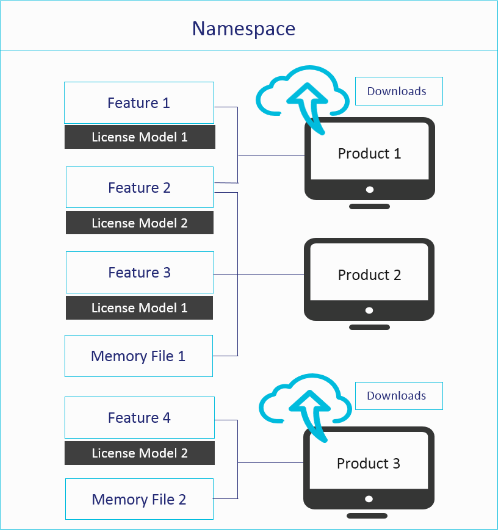
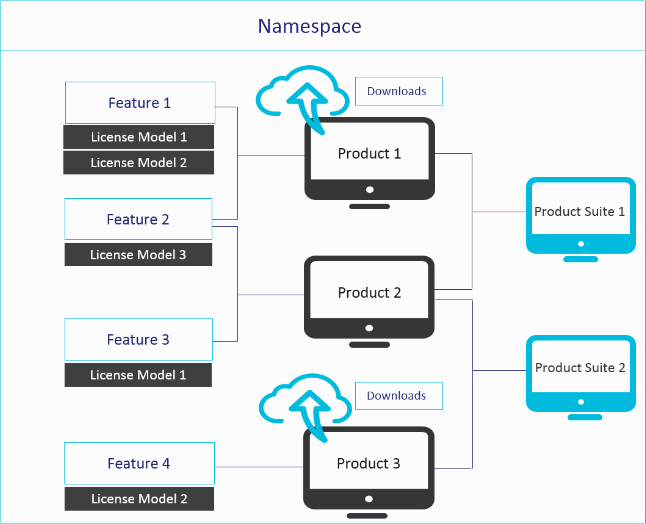
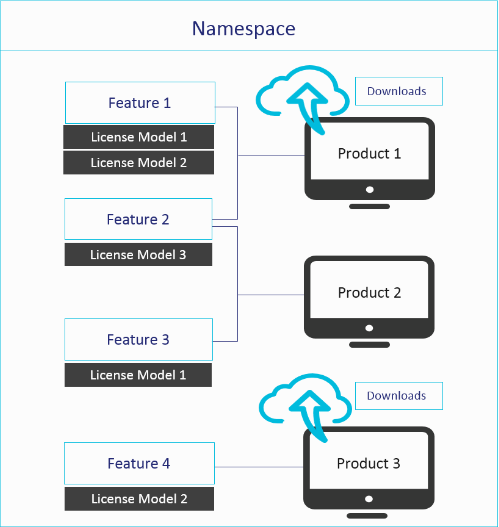
A namespace creates a workspace partition, which provides you with unique storage locations within Sentinel EMS. You can maintain separate namespaces to segregate and manage your catalog entities, such as products, based on your organization's structure or needs. For example, you can partition products across different product lines, various business units, or specific geographical locations.
You can also use namespaces to control vendor user access. You do this by granting permissions that enable a vendor user to access catalog entities only within a specific namespace. Vendor users with entitlement management permissions, such as order takers, can access all namespaces.
 Thales provides a default, out-of-the-box namespace that represents your company's unique batch code. You must retain the default namespace, but you are not required to use it. You can create and use your own, custom-defined namespaces as needed. The namespace for Sentinel protection keys with a demo vendor code is DEMOMA.
>Features: A feature is a distinct functionality of a software application that can be independently licensed. Features are the basic building blocks of a product. One or more features can be bundled into a product according to your product monetization model.
>
Memory: A data file that is used for storing strings in a Sentinel protection key.
>
Custom Clone Protection Schemes: A custom clone protection scheme that detects cloning for physical and virtual machines based on selected criteria.
>Products: A product is a salable entity that contains one or more bundled features
>Product Bundles: A product bundle is a catalog entity in Sentinel EMS that groups multiple products—including software, hardware, and services—into a single offering. Product bundles let you control how product quantities, entitlements, and activations are handled.
>

 Product Suites (Deprecated): A product suite is a combination of products that are meant to be sold together, according to your
product packaging plan.
Product Suites (Deprecated): A product suite is a combination of products that are meant to be sold together, according to your
product packaging plan.
>License Models: A license model defines the licensing conditions that control the use of a feature in a product.